
Paper-prototype a game before opening an engine
Use paper to test decisions and rules that do not depend on real-time feel. Represent the state with a few pieces, play several turns, and record where choices become obvious or confusing.
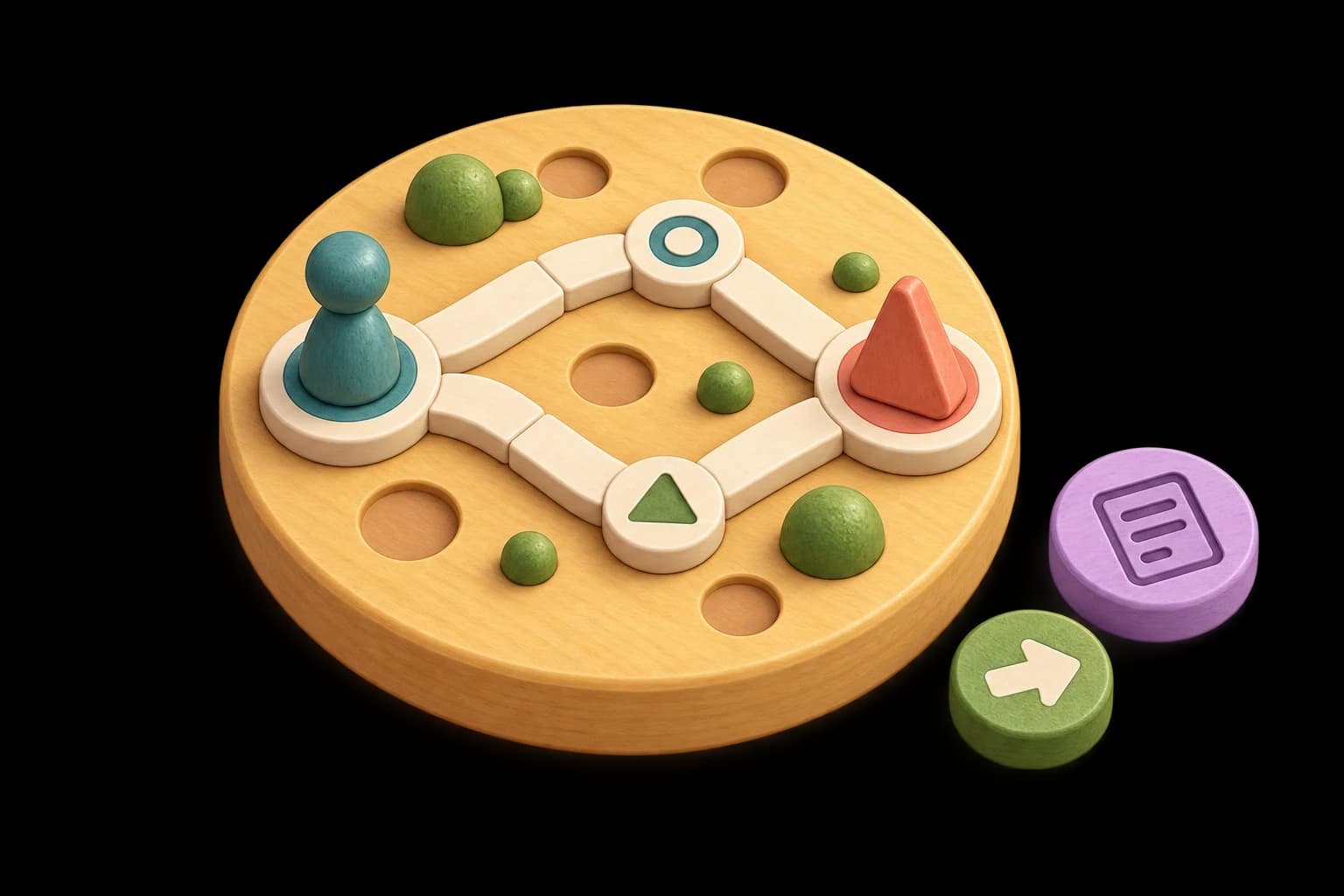
In this guide
An offline design exercise. Paper cannot establish movement feel, real-time physics, or device performance.
Choose a question paper can answer
Paper works well for turn order, resource tradeoffs, board placement, and many progression rules. It is less useful for the feel of a jump or the timing of a collision. Choose the prototype around the question.
For a parcel-delivery game, paper might test whether carrying more is worth the risk. It cannot tell you whether steering the loaded raft feels good. You may need two prototypes for those two questions.
Make only the pieces you need
Use labels instead of finished art. If you spend the evening illustrating the tokens, you have made attractive tokens. The rule still needs a test.
- A board or route drawn on paper.
- Tokens for the player and resources.
- Cards or notes for the available actions.
- A written turn order and end condition.
Play a full round without quietly changing rules
If you must make a ruling to continue, write it down. That ruling is part of the design and will need an answer in code later.
- Set up a known starting state.
- Follow the written turn order.
- Record unclear rules without fixing them halfway through a decision.
- Reach an ending, or note why the game cannot end.
- Revise the rule and start a new round.
Watch for choices that are not really choices
If one action is always best, ask what the alternative offers. If outcomes feel arbitrary, ask what information the player needs. Keep a record of actual moves rather than only whether you liked the session.
Try an extreme strategy on purpose. Hoard everything, spend immediately, or refuse to cooperate. A small prototype makes these tests cheap.
Carry the rule into a digital brief
Write the turn order, state changes, and examples you used. Give an assistant the specific cases the digital version must preserve. Then test the implemented game against those cases.
Expect the digital version to reveal new issues. Animation time, controls, and visual clarity change the experience. Paper helped answer one question; it did not finish the game for you.
Put your idea to work with the Dashpop Game Engine. Describe a game, play it quickly, and shape it yourself. Start with one change you can test.